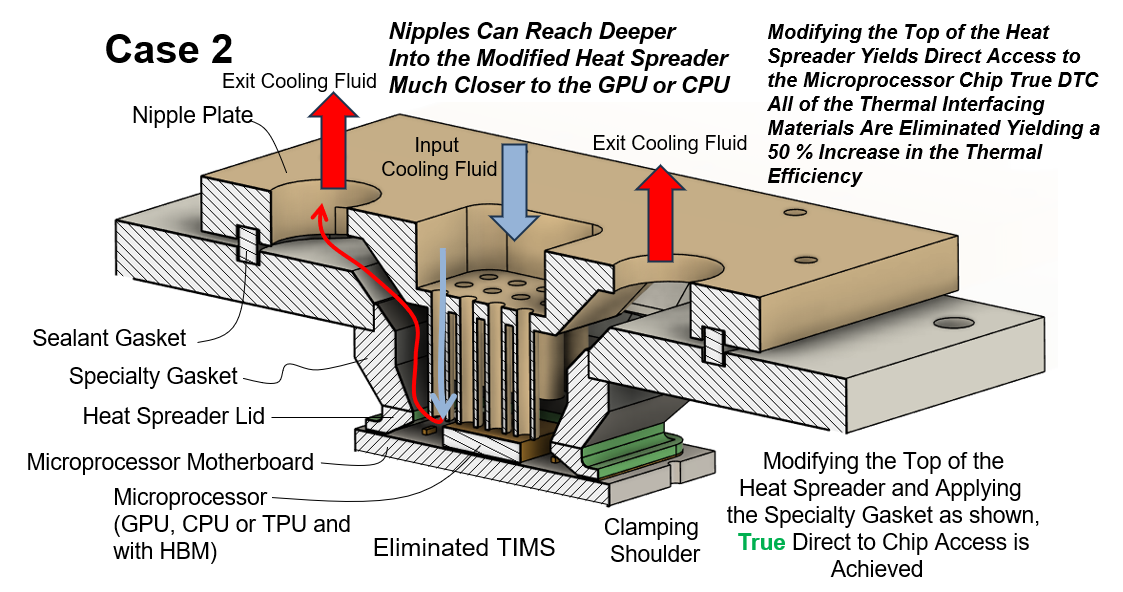
Apertured Heat Spreader
In advanced implementations, an aperture is formed in the heat spreader to expose the entire microprocessor die and the TIM layer. The TIM material is removed using standard de-lidding methods, bringing the cooling interface even closer to the silicon. Some microprocessor manufacturers already offer de-lidded devices for this purpose. Eliminating the TIM yields enormous efficiency gains—often in the range of 30% to 50%—by removing one of the largest sources of thermal resistance in the heat path. When a microprocessor is de-lidded, adjacent components may also be exposed; if a conductive coolant such as water is used, those components are electrically isolated with protective coatings such as parylene, and, where necessary, an additional layer may be applied to guard against erosion.
With the heat spreader apertured, the nozzle-impingement jets gain direct access to the top of the microprocessor or GPU die. Removing the intervening spreader material further reduces the pressure and volumetric flow required, driving the system toward even higher thermal efficiency. Importantly, the same mechanical clamping mechanism is retained, ensuring that the contact pressure remains sufficient to preserve proper electrical connectivity of the processor to the motherboard.
The internal sidewalls of each nozzle guide the incoming coolant directly to the hot surface of the die, while the external sidewalls channel the exiting fluid toward the outlet pathways. This architecture prevents entrainment or mixing between incoming and outgoing streams. The nozzles can be lowered to position the jet exits extremely close to the silicon surface, enabling effective operation at lower pressures and lower flow rates. By operating in the transition region between laminar and turbulent flow, the system minimizes erosion and mechanical stress on exposed components while maintaining exceptional heat transfer.
By combining direct die access, elimination of cold plates and TIMs, precision sealing with the specialty gasket, and controlled jet impingement with segregated inlet and outlet pathways, MezzoFluidics achieves a step-change in thermal performance. The result is a simpler, lower-pressure, lower-flow, and far more efficient cooling architecture—one that exceeds the limits of conventional cold plates and microchannel designs while improving reliability and extending the service life of high-power processors.